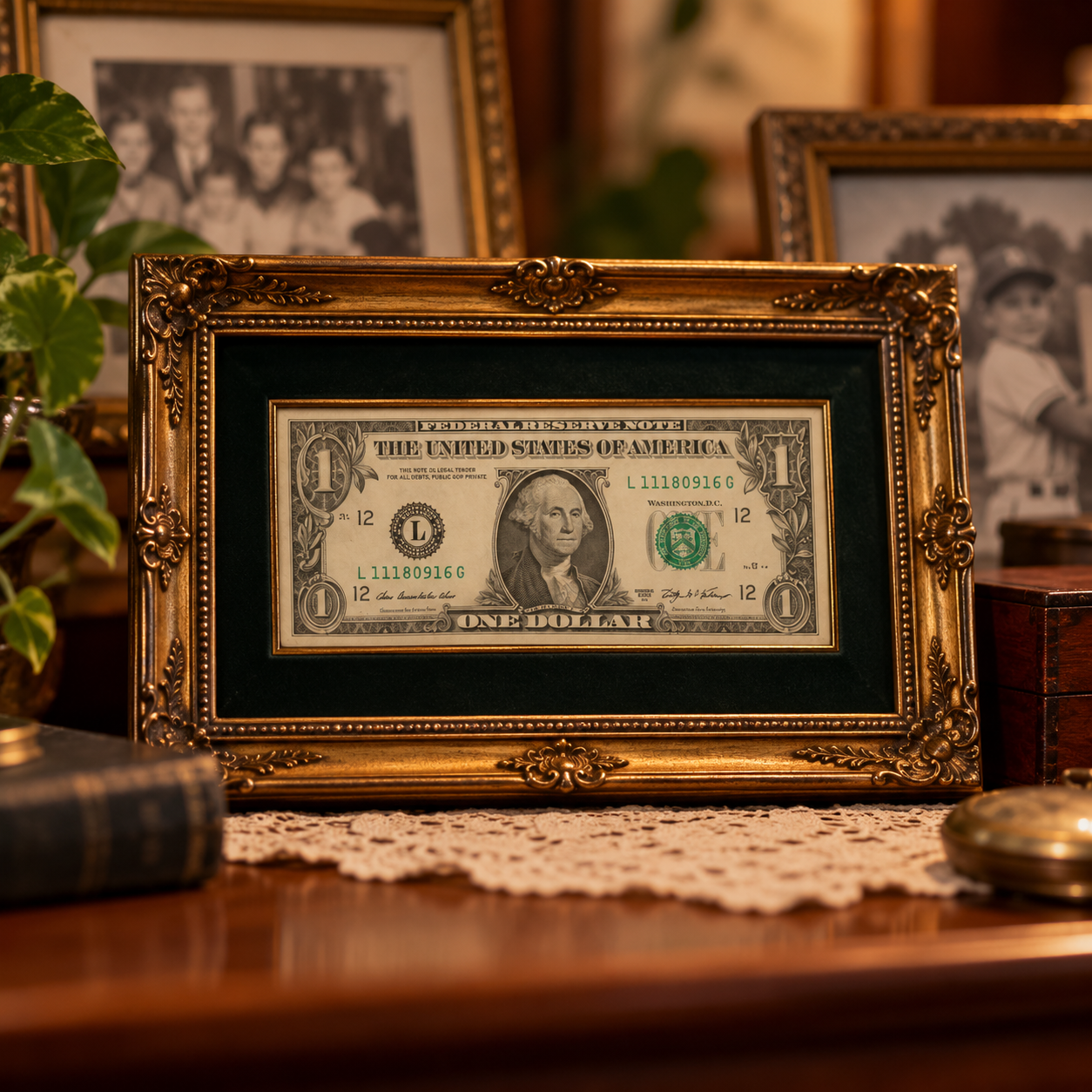
The most valuable thing my aunt’s father left behind was worth exactly one dollar.
My aunt’s father was a self-made man. He came from very little and eventually opened a dry-cleaning business in South Florida. When he earned his first dollar, he did something you probably don’t see much anymore: he taped it to the cinder-block wall behind the counter.
The business did well. As it grew, the little store got nicer. And somewhere along the way, that first dollar got an upgrade too. It came off the wall and went into a frame.
Eventually, the frame got nicer. Then the dollar came home with the family. And somewhere along the way, it got a name.
Georgie.
When a Dollar Stops Being a Dollar
Over the years, Georgie took on a life of his own. The family used the serial number for PIN codes and lock combinations.
Every Thanksgiving, they played Monopoly. It was a longtime family tradition, played for very high stakes: the winner got to hold Georgie—now proudly displayed in his fancy, annually updated frame—for that year’s family photo.
It was silly. It was fun. And it became part of their family story. By then, Georgie obviously wasn’t really worth a dollar anymore. Not to them.
He Had a Trust. But the Trust Didn’t Say Who Got Georgie.
When my aunt’s father died, he actually had a Trust!
That was pretty unusual at the time. Back then, unless someone had serious money, estate planning often wasn’t something families thought much about. He did. He had planned for what would happen to his estate. But he hadn’t planned for Georgie.
One of the three sisters lived nearby. The other two lived in New York and New Jersey. The sister who lived closest got to the house first—and ransacked the place, taking the things she wanted. Including Georgie.
By the next day, everyone was there. The solution seemed obvious. There were three sisters and twelve months in a year. Each sister could have Georgie for four months. But the sister who had him wouldn’t give him up.
And that was that. The three sisters stopped speaking. Not for a month. Not for a year. For about 30 years. Their children, who had grown up together and spent holidays together, lost those relationships too.
All over a dollar bill. Except, of course, it was never really about a dollar bill.
Families Don’t Measure Value in Dollars
When we talk about estate planning, we naturally focus on the big things. The house. Bank and investment accounts. Retirement accounts. Life insurance. Those things matter.
But sometimes the things that mean the most to a family aren’t worth very much at all.
Dad’s watch.
Mom’s wedding ring.
Grandma’s recipe book.
A baseball glove.
A box of holiday decorations, some handmade.
Or a dollar bill that hung on the wall of a dry cleaner decades ago.
You may know exactly what those things mean to you. That doesn’t mean your children know what you want to happen to them. And it certainly doesn’t mean your children will agree about it after you’re gone.
Don’t Assume They’ll Work It Out
I hear some version of this all the time: “My kids will figure it out.”
Maybe they will. But grief does funny things to people. So do memories. And relationships. And rivalries.
Two children can look at the same object and attach completely different meanings to it. And sometimes neither one is really fighting over the object. They’re fighting over what it represents — a memory, an old hurt, or a lifetime of believing the other one was favored.
That’s why we help our clients plan for these things too.
Our clients can use a separate personal property list that is incorporated by reference into their Trust. That means the list isn’t just a suggestion to the family. It becomes part of the plan the Trustee is supposed to follow.
And unlike the Trust itself, the list is easy to change. If you decide your granddaughter should get your necklace, put it on the list. Change your mind later? Update the list. Sign it. Date it.
No notary. No trip to our office every time you decide somebody else should get the grandfather clock. It gives you the flexibility to keep making decisions as life changes, while giving the person handling your estate clear instructions when the time comes.
But there’s another option we sometimes talk about with clients.
Maybe You Don’t Have to Wait
I once had a client who had two watches he wanted his grandsons to have someday. He adored those boys. He loved going to their Little League games and watching them play. The watches were sitting in his bedside table, waiting.
I asked him whether he wore them. He didn’t.
So I asked him a pretty simple question. “Why not give them to the boys now?” Why leave the watches sitting in a drawer for years so the boys can receive them after Grandpa is gone? Give them the watches now. Tell them the story behind them. Let Grandpa see them wear the watches. Let him see whether they treasure them.
The thought had never occurred to him. He just assumed that’s what you do: leave things to the people you love when you die.
He decided to do it.
I’ve always loved that idea because, in a way, there were two gifts.
The boys got Grandpa’s watches. And Grandpa got to watch them receive them.
Your Estate Plan Should Reflect Your Story
That’s one of the things I’ve learned after doing this for a long time.
Every family is different. And “family” doesn’t look the same for everyone. It may be the family you were born into, the family you married into, or, as Leann likes to say, the family you choose.
You have different people you love, different relationships, different concerns, different stories, and different things that matter to you.
That’s why good estate planning can’t just be about getting the documents right. We have to understand you and your family well enough to know what questions to ask.
My client with the watches thought he already had a plan. The watches were sitting safely in his bedside table, and someday his grandsons would get them. There was nothing wrong with that plan.
But once I understood how much he loved those boys and how much joy he got from watching them play Little League, there was another question worth asking:
Why wait?
That’s why we listen. That’s why we ask questions. And that’s why your estate plan should reflect more than what you own.
It should reflect your story.
What’s Your Georgie?
Look around your house sometime. Not for the most expensive thing you own. Look for the things that tell your family’s story.
Maybe it’s a watch.
Maybe it’s the ugly red sweater your Dad insisted on wearing.
Maybe it’s a piece of jewelry with a story behind it.
Maybe it’s the hideous ceramic bowl your kids made fun of for years.
Maybe it’s the record collection nobody was allowed to touch.
Or maybe it’s a one-dollar bill in a fancy frame.
If there’s something you know would matter to someone you love, don’t assume everyone will know what you wanted. Make a plan for it. Talk about it. Put it on your personal property list. Or maybe give it to them now.
Because sometimes the best gift you leave someone is the one you get to watch them receive.

- The Most Valuable Thing in His Estate Was Worth One Dollar - September 28, 2026
- The Estate Planning Choice You Probably Don’t Know You Have - July 29, 2026
- The “I Added My Kid to My Deed” Mistake (and Other Common Estate Planning Pitfalls) - June 30, 2026